
Kineton C of E Primary School
Special Educational Needs
Special Educational Needs & Disabilities (SEND) Information Report 2026-2027
Important information for Parents and Carers
Introduction:
At Kineton Primary School we strive to deliver high quality provision for children with special educational needs and disabilities (SEND) and to improve their educational outcomes and access to a broad range of social opportunities. To successfully achieve this we aim to build strong, collaborative partnerships with our families and provide a high-quality educational experience that ensures every child can flourish, making good progress academically, socially, and emotionally. We will endeavour to do all we can to deliver effective provision for individual SEND children so they can make good progress, reach their potential and successfully move on to the next stage of their education. We continually work to build a culture that gives all children a sense of belonging. We also collaborate with our partners including external agencies and the local authority to work together and share good practice to enable the needs of all children to be met to the highest possible standard.
What is the Special Education Needs Information Report?
The aim of this information report is to explain how we implement our SEND policy. In other words, we want to show you how SEND support works within our school.
If you want to know more about our arrangements for SEND, you can read our SEND policy.
You can find it here.
What types of SEND does Kineton Primary School provide support for?
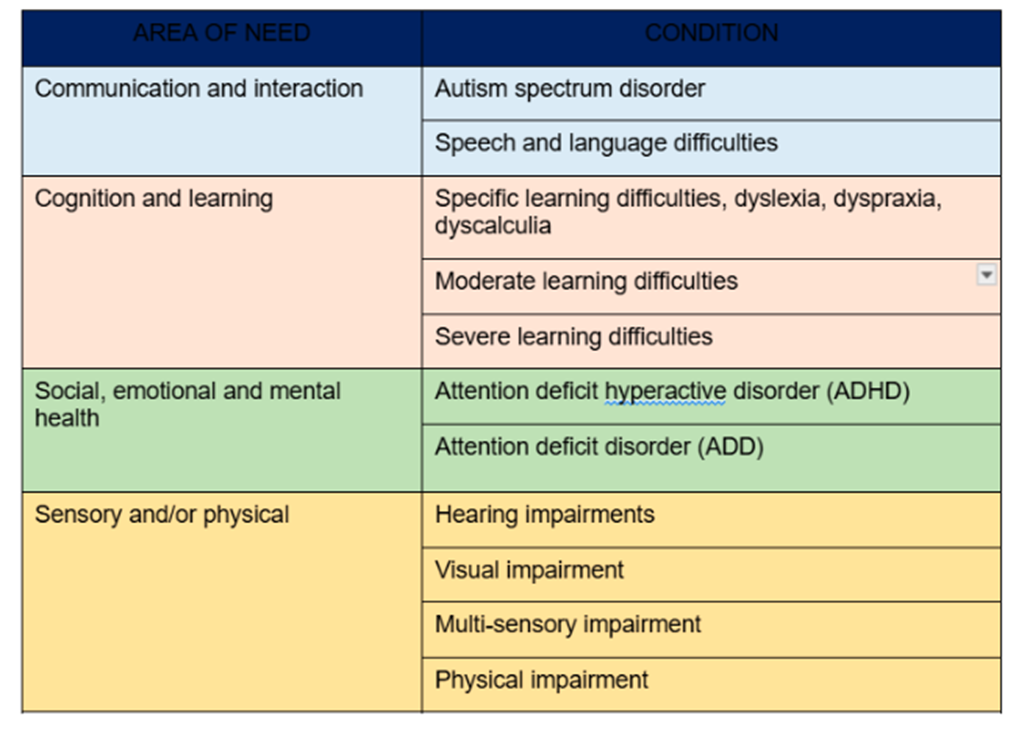
The four broad areas of SEND need are:
• Communication and Interaction
• Cognition and Learning
• Social, Emotional and Mental Health Difficulties
• Sensory and/or Physical
Our school provides support for pupils with a wide range of SEND needs including the following:
Who are the best people to talk to about my child’s difficulties with Special Educational Needs or disability (SEND)?
There are several members of staff you can talk to at Kineton Primary School, regarding your child’s learning or SEND.
In the first instance please talk to your child’s Class Teacher, they are responsible for:
• Checking your child’s progress and identifying, planning and delivering any initial additional help your child may need and letting the Special Education Needs/Disabilities Coordinator (School SENDCo) know as necessary.
• Writing Individual Learning Plans (ILP) and sharing and reviewing these with parents three times in the academic year in November, February and June.
• Ensuring that the school’s SEND Policy is followed in their classroom.
You can also talk to Mrs Field, the School SENDCO. The School SENDCo is responsible for:
- The daily operation of the school’s SEND policy.
- Coordinating the support for children with SEND.
- Ensuring that you are involved in supporting your child’s learning, kept informed about the support your child is getting and involved in reviewing how they are doing.
- Liaising with all the other people who may be coming into school to help support your child’s learning e.g., Speech and Language Therapy, Educational Psychology etc.
- Updating the school’s SEND register (a system for ensuring that all the SEND needs of pupils in this school are known) and making sure that records of your child’s progress and needs are kept.
- Providing training and specialist support for teachers and support staff in the school so that they can help children with SEND in the school to achieve the best progress possible.
- Monitoring the success of planned interventions.
You can also talk to Mrs Pang, our Trust Head of Inclusion. The Trust Head of Inclusion is responsible for:
- The strategic development of the Trust’s Special Education Needs and Disabilities strategy with the aim of raising SEND pupil achievement and wellbeing across all schools in the Trust.
- Collaborating with the Local Academy Council and Headteacher, as part of the SLT, to determine the strategic development of the SEND policy and provision in the school.
- Promoting inclusion and inclusive practice across all the schools in The Stour Federation and taking responsibility for the leadership of provision for pupils with SEND.
- Providing professional guidance and accountability to staff across the Trust in the area of SEND.
- Being a key point of contact for external agencies, especially the LA and LA support services.
You are also welcome to talk to our Headteacher, Mrs Mitchell-Hilton. She is responsible for:
- The day to day management of all aspects of the school, including the support for children with SEND.
- Making sure that the Local Academy Council is kept up to date about issues relating to SEND.
We also have a SEND Governor, Adam Sharpe, who takes a special interest in SEND, and meets with our SENDCo on a regular basis. The Local Academy Council has overall responsibility for ensuring that the necessary support is given for any child who attends the school, and that appropriate support is provided for all SEND pupils.
Parents are welcome to approach the school in person, initially via our school office or Class Teachers. Alternatively, you can make contact with us by email or telephone:
Email: admin3308@welearn365.com or Telephone: 01926 640 397
What different types of support are available for children with SEND in our school?
Class teacher input via excellent and targeted classroom adaptive teaching.
For your child this means:
- That the teacher has the highest possible expectations for your child and all pupils in their class.
- That all teaching is built on what your child already knows, can do, and can understand.
- Different ways of teaching are in place so that your child is fully involved in learning in class and ‘in the moment’ adaptations are made in each lesson. This may involve things like using more practical learning.
- Specific strategies (which may be suggested by the School SENDCo) are in place to support your child to learn.
- Your child’s teacher will have carefully checked on your child’s progress and may have decided that your child has a gap or gaps in their understanding/learning and needs some extra support to help them make the best possible progress.
Specific group work and interventions which may be:
- Delivered in the classroom or outside
- Delivered by a teacher or a teaching assistant (TA)
Specialist support as defined by a qualified outside agency e.g., Speech and Language Therapy - as per the SEN Code of Practice 2014: School Support (SS):
This means that the child has been identified by the School SENDCo as needing some extra specialist support in school from a professional outside the school.
This may be from:
- Local Authority central services, such as the Integrated Disability Service (including services such as, the Physiotherapy and Occupational therapy teams, Hearing Impairment Service, and the Complex needs team).
- Warwickshire Specialist Teacher Service.
- An Education Psychologist.
- An NHS support service, such as Speech and Language Therapy.
If the School SENDCo refers your child to an outside agency for further support or assessment you will be asked to give your permission. This will help the school and you to understand your child’s particular needs better and for us to be able to support them better in school. The specialist professional will work with your child to understand their needs and make recommendations as to the ways your child is given support.
Specified Individual support
This type of support is available for children whose learning needs are significant and complex. This is usually provided via an Education, Health and Care Plan (EHCP). This means your child will have been identified by professionals as needing a particularly high level of support and provision.
This type of support is available for children with specific barriers to learning that cannot be overcome through Adaptive Teaching and intervention groups. The school (or you) can request that Local Authority Services carry out a statutory assessment of your child’s needs. This is a legal process which sets out the amount of support that will be provided for your child.
- After the request has been made to the ‘Panel of Professionals’ (with a lot of information about your child, including some from you), they will decide whether they think your child’s needs (as described in the paperwork provided), seem complex enough to need a statutory assessment. If this is the case, they will ask you and all professionals involved with your child to write a report outlining your child’s needs. If they do not think your child needs this, they will ask the school to continue with the current support.
- After the reports have all been sent in, the ‘Panel of Professionals’ will decide if your child needs an Educational Health Care Plan (EHCP). If this is not the case, they will ask the school to continue with the current level of support and also set up a meeting in school to ensure a plan is in place to ensure your child makes as much progress as possible.
- The EHCP will outline the number of hours of individual/small group support your child will receive from the LA and how the support should be used and what strategies must be put in place. It will also have long and short-term goals for your child.
How can I let the school know I am concerned about my child’s progress in school?
- If you have concerns about your child’s progress, please speak to your child’s class teacher in the first instance.
- If you continue to be concerned that your child is not making progress, you may speak to the School SENDCO.
- The Trust Head of Inclusion or Headteacher can also be contacted if concerns remain.
How will the school let me know if they have any concerns about my child’s learning in school?
If your child is identified as not making progress, or if staff have a particular concern, the school will set up a meeting to discuss this with you in more detail and to:
- Listen to any concerns you may have
- Collaboratively plan any additional support your child may need
- Discuss with you any referrals to outside professionals to support your child’s learning
Who supports children with SEND at Kineton Primary School?
All teachers and teaching assistants at Kineton Primary School support children with special educational needs through adaptive teaching and additional targeted support where required. All of our teachers are trained in SEND.
Our staff members have taken part in a wide range of specialised training as part of their ongoing CPD and so that we can ensure we are prepared to support children with special educational needs. This training has recently included:
- Communication and Interaction:
- AET Making Sense of Autism
- AET Good Autism Practice.
- Autism and Writing.
- Makaton.
- Warwickshire Time to Talk, levels 1, 2 and 3.
Social Emotional and Mental Health:
- ADHD Awareness.
- Attachment and Trauma.
- Thrive Approach.
- Thrive Practitioner Training.
- Demand Avoidance.
- Emotional Based School Avoidance.
- Schools Mental Health Network – Self Harm.
- Schools Mental Health Network – Anxiety.
Cognition and Learning:
- Supporting Children with Complex Needs.
- Implementation of the Engagement Model.
Sensory and Physical:
- Gastrostomy Tube Training.
- Further specialised medical training.
- support and training for hearing impairments.
Who are the other people providing services to children with SEND at Kineton Primary School?
Sometimes we need extra help to offer our pupils the support that they need. Whenever necessary we will work with external support services to meet the needs of our pupils with SEND and to support their families. These include:
- Speech and language therapists.
- Educational psychologists.
- Specialist teachers.
- Occupational therapists.
- GPs and paediatricians.
- The Community nursing team.
- Connect 4 Health.
- MHST
- Warwickshire Rise.
- Social services and other LA-provided support services.
How will the teaching and learning be adapted for my child with SEND?
- Class teachers plan lessons according to the specific needs of all groups of children in their class, and will ensure that your child’s needs are met.
- Support staff, under the direction of the class teacher, can adapt planning to support the needs of your child where necessary.
- Specific resources and strategies will be used to support your child individually, in groups and during whole class teaching.
- Planning and teaching will be adapted daily and in the moment, if needed, to meet your child’s learning needs.
- Additional interventions may be planned to meet specific needs of pupils either on an individual basis or in small groups.
How will we measure the progress of your child in school?
- Your child’s progress is continually monitored by their class teacher.
- Their progress is reviewed formally every term in reading, writing and mathematics by the class teacher and the Headteacher in Pupil Progress Review meetings.
- In Reception every child is assessed by the class teacher to ensure they are on track to have a good level of development.
- If your child is in Year 1 or above, a more sensitive assessment tool can be used, which shows their attainment in more detail (Pre Key Stage Standards)
- All Year 1 pupils complete a National Phonics Screening Check. Some children will complete this check for a second time in year 2.
- In Year 4, children complete the Multiplication Tables Check.
- In Year 6, all children are required to be formally assessed using Standard Assessment Tests (SATS). This is something the government requires all schools to do, and the results are published nationally.
- Children on the SEND register may have an Individual Learning Plan (ILP) which will be reviewed 3 times a year. We follow the ‘Graduated Approach’ to support children on the SEND register with an Individual Learning Plan.
The progress of children with an EHCP is tracked throughout the year and is formally reviewed at an Annual Review, with all adults involved with the child’s education.
The School SENDCO will also check that your child is making good progress within any individual work and in any group that they take part in.

What support do we have for you as a parent of a child with a SEND?
- The class teacher is regularly available to discuss your child’s progress or any concerns you may have and to share information about what is working well at home and school so similar strategies can be used.
- The School SENDCo is available to talk with you to discuss your child’s progress or any concerns/worries you may have.
- All information from outside professionals will be discussed with you and the person involved directly, or where this is not possible, in a report.
- Individual Learning Plans will be reviewed with your involvement.
How is Kineton Primary School accessible to children with SEND?
We have a disabled toilet, ramp and adaptations are available in classrooms to support the individual needs of children, e.g. enlarged print, coloured overlays, wobble cushions, pencil grips.
Please see the School’s Accessibility Policy and Plan here.
Admission Arrangements for Pupils with SEND
Pupils without an EHCP: Children with special educational needs but without an Education, Health and Care Plan (EHCP) are admitted through the standard Warwickshire County Council primary admissions process. The school cannot refuse admission solely because a child has a special educational need or disability.
Pupils with an EHCP: Admissions for pupils with an EHCP are handled separately via Warwickshire County Council’s SEND team. Where Kineton Primary School is named on a child’s EHCP, the school has a statutory duty to admit the pupil, provided the placement is suitable for the child's age, ability, and aptitude, and does not clash with the efficient education of others or the efficient use of resources.
Steps Taken to Prevent Pupils with SEND from Being Treated Less Favourably
At Kineton Primary School, we firmly believe that exceptional SEND provision requires both full inclusion and high standards. Inclusion does not mean lowering expectations, and high standards are only truly achieved when every child, regardless of need, is supported to reach their full potential. We ensure this balance through:
- Full Inclusion in the Curriculum and School Life: All pupils with SEND are given equal access to our broad curriculum, extra-curricular clubs, educational visits, residential trips, and school events.
- Reasonable Adjustments: Staff proactively plan lessons and activities to make necessary adaptations, ensuring physical, social, and academic barriers are removed.
- Targeted Support & Resources: Risk assessments and individual management plans are created alongside parents and medical professionals where required to ensure pupils with SEND participate fully alongside their peers without disadvantage.
- A Culture of Belonging & Mutual Respect: High standards extend to our school culture. We actively celebrate diversity, foster a strong sense of belonging, and rigorously enforce our Anti-Bullying Policy to create an environment where every child feels safe, valued, and empowered to excel.
How will we support your child when they are starting or leaving this school? OR moving on to another class?
We recognise that transitions can be difficult for a child with SEND and take steps to ensure that any transition is as smooth as possible.
If your child is moving child to another school:
- We will contact the school SENDCo and ensure s/he knows about any special arrangements or support that need to be made for your child.
- We will make sure that all records about your child are passed on to the new school.
When moving classes in school:
- Information will be passed on to the new class teacher in advance and a planning meeting will take place with the new teacher. Individual Learning Plans and EHCPs will be shared with the new teacher.
- Your child will take part in transition visits to their new class in order to familiarise themselves with their new environment and get to know their new class teacher and, where applicable, any teaching assistants with whom they will be working.
- Additional transition activities will be planned for individuals depending on their needs.
When starting in Reception:
- We hold a transition meeting with the parents of children whose needs have already been identified before the summer. The School SENDCo and class teacher will also discuss the specific needs of your child with their nursery key worker, and any external professionals who have been working with your child.
- You will also have an opportunity to raise any concerns regarding your child with their class teacher during the new parent meeting in the summer term.
When leaving in Year 6:
- The School SENDCo and Year 6 teacher will discuss the specific needs of your child with the SENDCo of their secondary school.
- Your child will engage in focussed learning about aspects of transition to support their understanding of the changes ahead.
- Where possible your child will visit their new school.
- Usually, a member of staff from the new school will visit your child in this school.
What Emotional and Social Development support do we have for a child with a SEND?
We recognise that pupils with SEND may well have an emotional and social development need that will require support in school.
The emotional health and well-being of all our pupils is very important to us. It is fundamental to their ability to flourish, which is why we have embedded the Thrive approach.

Thrive is a systematic approach to the early identification of emotional developmental needs in children and young people so that differentiated provision can be put in place by an adult working closely with them.
Addressing emotional development will build resilience and resourcefulness, it decreases the risk of mental illness, and reinvigorates to help those children who may be underachieving for whatever reason, to re-engage with learning.
The Thrive process consists of informed up-to-date neuroscience, attachment research, learning theory, child development studies and research into risk and resilience factors. Through an online assessment, action planning and measurement tool, Thrive enables us to clearly and systematically identify the social and emotional needs of the children we are working with, and to select targeted actions to meet the needs of the individual, giving suggestions on how to be and what to do in order to meet those needs through the arts, creativity and play.
Miss Herdman and Mrs Faulkner are both licensed Thrive Practitioners and support our Thrive provision.
How do you support children with SEND with attendance?
Kineton Primary School is a member of The Stour Federation Multi Academy Trust, which is proudly recognised as an Inclusive Attendance academy trust. Our unwavering commitment to attendance centres around child-centric actions, evidence-informed practices, and a shared understanding of everyone's roles and collective responsibilities to promote exceptional attendance.

We recognise that children with special educational needs and disabilities may require additional support and accommodations to attend school regularly and that failure to provide appropriate support can lead to absences.
We will support children and their parents and carers to overcome barriers to attendance and all staff members have received training to support this.
Please see our Trust Attendance Policy for further information on our policy page here.
In August 2024, the Department for Education published 'Working Together to Improve School Attendance.' The document includes a summary table that outlines the responsibilities for supporting children with medical conditions or Special Educational Needs and Disabilities (SEND) who have poor attendance. The table below details these expectations.
What support is in place for looked-after and previously looked-after children with SEND?
Mrs Mitchell-Hilton, Headteacher, is the designated teacher for looked-after children and previously looked-after children. Mrs Mitchell-Hilton will make sure that all teachers understand how a looked-after or previously looked-after pupil’s circumstances and their SEND might interact, and what the implications are for teaching and learning.
Children who are looked-after or previously looked-after will be supported much in the same way as any other child who has SEND. However, looked-after pupils will also have a personal education plan (PEP). We will make sure that the PEP and any SEND support plans or EHCP are consistent and complement one another.
What is SENDIASS?
SENDIASS stands for special educational needs and disability information advice and support service. Children, young people and their parents and carers where a child or young person has or may have special educational needs or a disability are able to access the service for free, impartial and confidential information and advice.
Warwickshire SENDIASS provides advice and support around various topics relating to special educational needs and disabilities (SEND) for children and young people aged 0-25 living in Warwickshire and their parents or carers. This is in line with the SEND Code of Practice, which states that “Local authorities must arrange for children with SEND for whom they are responsible, and their parents, and young people with SEND for whom they are responsible, to be provided with information and advice about matters relating to their SEND, including matters relating to health and social care.”
For more information about how SENDIASS may be able to help visit their website: https://www.warwickshiresendiass.co.uk/ or contact them by email: warwickshiresendiass@barnardos.org.uk or phone: 01788 593159.
What is the LA Local Offer?
The Children and Families Bill was enacted in September 2014. From this date Local Authorities (LA) and schools are required to publish and keep under review information about services they expect to be available for children and young people with special educational needs (SEN) aged 0- 25. The LA refers to this as the 'Local Offer'. The intention of the Local Offer is to improve choice and transparency for families. It will also be an important resource for parents in understanding the range of services and provision locally. The Local Offer can be accessed via the Local Authority website.
https://www.warwickshire.gov.uk/send
What should I do if I have a complaint about my child’s SEND Support?
Please see our school Complaints Policy, you can access here.